CAPABILITY 04: VERIFICATION
Aircraft design verification, sold as the deliverable.
Genesis Ventures sells aircraft design verification as an artefact in its own right: a check matrix with thresholds declared before the run, every published figure measured against them, and scripted 6-DoF flight test simulation receipts. The Orion release passed all nineteen published checks. The Orion-T1 simulation passed six scripted cards.
Scope
What an engagement in this capability covers, scoped against your mission profile at the requirements gate.
- Aircraft design verification scoped against your requirements: thresholds declared before the run
- Check matrices built from the brief: every figure carries the requirement it was held against
- 6-DoF flight test simulation with scripted test cards and expectations declared in advance
- Installed-vs-cycle correlation checks, published with the error shown
- Re-verification of existing designs: bring the model, leave with the receipts
Aircraft design verification starts with declared requirements.
A verdict becomes reviewable when the requirement and measured value appear together. Orion publishes 19 automated checks in that form. The set spans cycle performance, mass, envelope dimensions, shaft-power balance, compressor conditions, nozzle behavior and spool speed.
The TSFC check records 99.2591 kg/(kN·h) against a requirement of ≤ 100. The advanced-construction dry-mass line records 165.2018 kg against ≤ 170. The published values expose the margin behind each pass.
Requirements are frozen before the run. Candidate designs can then pass, fail or remain open against the same matrix. The rejected Orion cycle point stays in the record because its miss is part of the verification trail and explains the selected configuration.
Release verification covers geometry and deterministic replay.
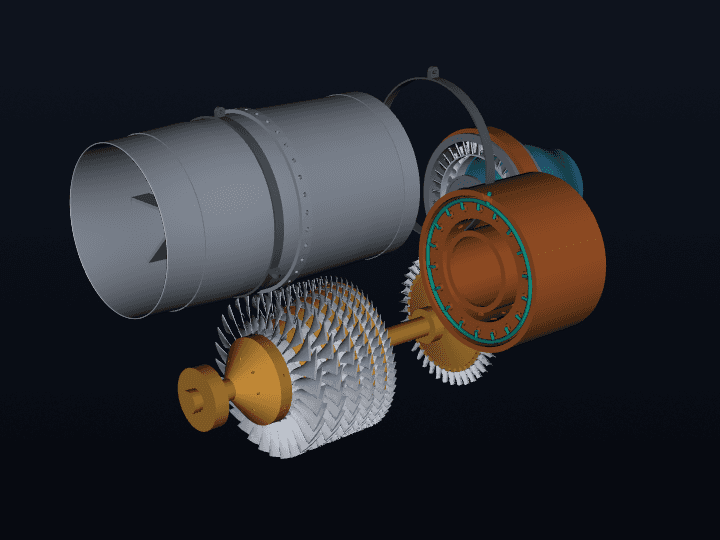
The Orion release mesh records 5,252,496 triangles and 0 boundary and non-manifold edges. The CAD assembly contains 561 named solids. These topology and assembly values sit beside the thermodynamic checks in the same release.
The package re-executed on its own bundled runtime reproduces 19/19 checks and a byte-identical repaired STL (SHA-256 30af8b13…). The replay receipt connects the published verdict to a repeatable package output.
Geometry verification and cycle verification answer different questions. The check matrix tests declared performance and mechanical anchors. The topology receipt checks the release mesh. Deterministic replay checks that the sealed package reproduces its published result. Keeping those evidence types separate makes the review trail legible.
6-DoF flight test simulation uses scripted cards.
The Orion-T1 concept adds 6 scripted 6-DoF simulation cards. Each card names the condition, expected behavior and measured model response. The set covers trim, launch separation, maximum level speed, climb, sustained turn, and fuel and thrust anchors.
The trim card runs at 5 km / M0.70 and reports α −0.47°, throttle 0.411; 30 s drift Δh 66 ft, ΔM 0.002. The sustained-turn card runs at 30° bank, 5 km, 60 s and reports mean bank 29.6°, max |Δh| 17 ft against an expectation of altitude within ±164 ft.
The fuel and thrust card checks the engine deck inside the aircraft model. Its measured result is TSFC 129.0 vs cycle 128.9; thrust error 2.3% and 4.1%, inside the declared expectation of within ±10% of the cycle model. These are simulation receipts, stated at the evidence level that produced them.
Published verification evidence
The rows combine Orion automated checks with Orion-T1 6-DoF simulation cards. The basis column identifies the evidence type.
| MEASURE | VALUE | BASIS |
|---|---|---|
| Orion automated checks | 19/19 | Measured value against declared requirement |
| Sea-level static TSFC meets the redesign target | 99.2591 kg/(kN·h) | Requirement ≤ 100 |
| Advanced-construction dry mass meets target | 165.2018 kg | Requirement ≤ 170 |
| Release mesh topology | 0 boundary and non-manifold edges | 5,252,496 triangles |
| Trim simulation | α −0.47°, throttle 0.411; 30 s drift Δh 66 ft, ΔM 0.002 | 5 km / M0.70 |
| Sustained turn simulation | mean bank 29.6°, max |Δh| 17 ft | 30° bank, 5 km, 60 s |
| Fuel & thrust anchors simulation | TSFC 129.0 vs cycle 128.9; thrust error 2.3% and 4.1% | within ±10% of the cycle model |
What you get
Each gate ends with a customer-facing deliverable. The full five-gate sequence is on how we work.
- 01A check matrix with every threshold declared before the run
- 02Measured value against requirement for every check: pass and margin shown
- 036-DoF simulation receipts: scripted cards, measured model results, verdicts
- 04A verification report you can hand to your own reviewers
Proof: Orion 13.34 kN release
- 19/19 published checks passed, thresholds declared first
- The rejected design point stayed on the record
- Orion-T1: six 6-DoF tests, six passes, TSFC 129.0 vs cycle 128.9
Technical reading for this capability
Buyer guides and checklists tied to the same published evidence.
- Nineteen checks, nineteen passes
Why measured values and declared thresholds belong on the same line.
- Concept versus detailed design and qualification
Match each claim to the stage and artefact that can support it.
- Turbojet concept design deliverables
How the check matrix, geometry receipts and sealed release fit together.
Verification delivered at the evidence level used.
The verification package delivers measured values beside declared requirements, geometry receipts, deterministic replay evidence and scripted 6-DoF simulation cards. Orion provides the engine design and release checks. Orion-T1 provides simulation results from the aircraft model. Later hardware and certification stages carry their own requirements and evidence.
Bring the mission profile.
Payload, envelope, timeline, constraints: one line is enough to begin. Common questions are answered on the FAQ.
[email protected]