GT1 Fuel Manifold: 18 for 18
First fuel-system part for the GT1 core: one ring, eighteen injector stems, one inlet: every injector tip measured onto its swirler axis. 18 for 18.
The GT1 core just grew a fuel system. The first part of it (GT1-FUE-001, the fuel manifold and injector set) now exists as a verified solid: one ring, eighteen injector stems, one external inlet boss, generated parametrically and measured against the engine it has to live inside.
This is the part that feeds the combustor. The dome of that combustor carries eighteen axial swirlers on a fixed pitch circle, and the requirement was blunt: one injector tip on every swirler axis, no exceptions, with every clearance against the already-released combustor hardware proven by measurement rather than assumed.
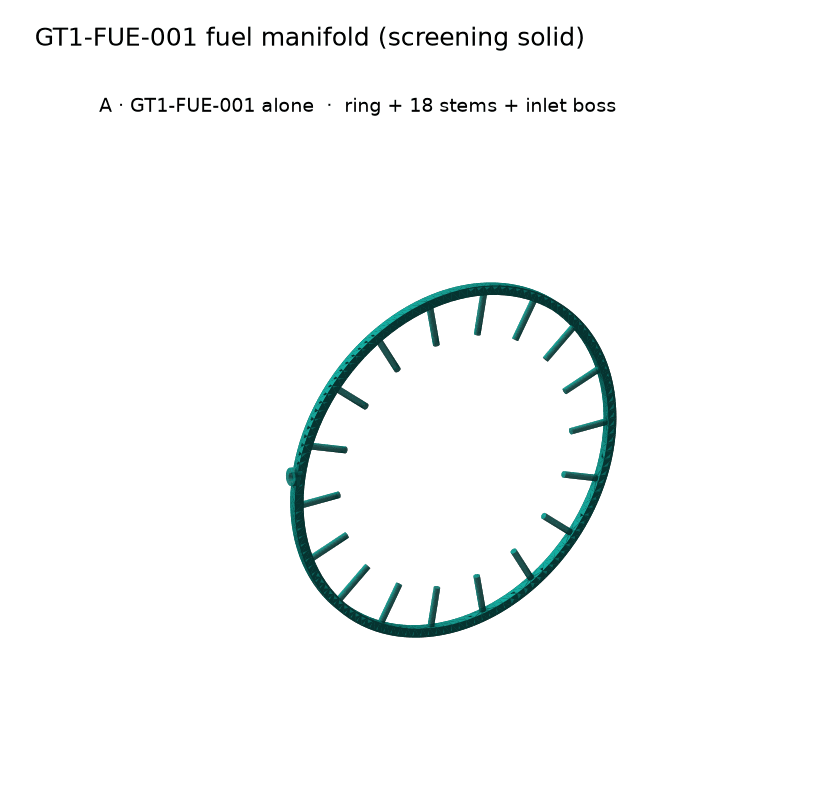
18 for 18
The verification trail is the story. Every claim about this part was measured from the re-imported STEP solid, not from the designer's intent:
- Watertight solid, exported and re-imported with the geometry intact to one part in a million.
- 18 of 18 injector tips on their swirler axes: each one checked against the dome's measured bore positions, not the nominal drawing.
- Zero interference with the combustor dome, casings and the diffuser casing upstream: every contact checked by boolean, every necessary passage through structure declared explicitly.
- Fuel velocity inside the manifold passage comfortably under its budget at the full rated Jet A-1 flow: the internal passage is modelled, not hand-waved.
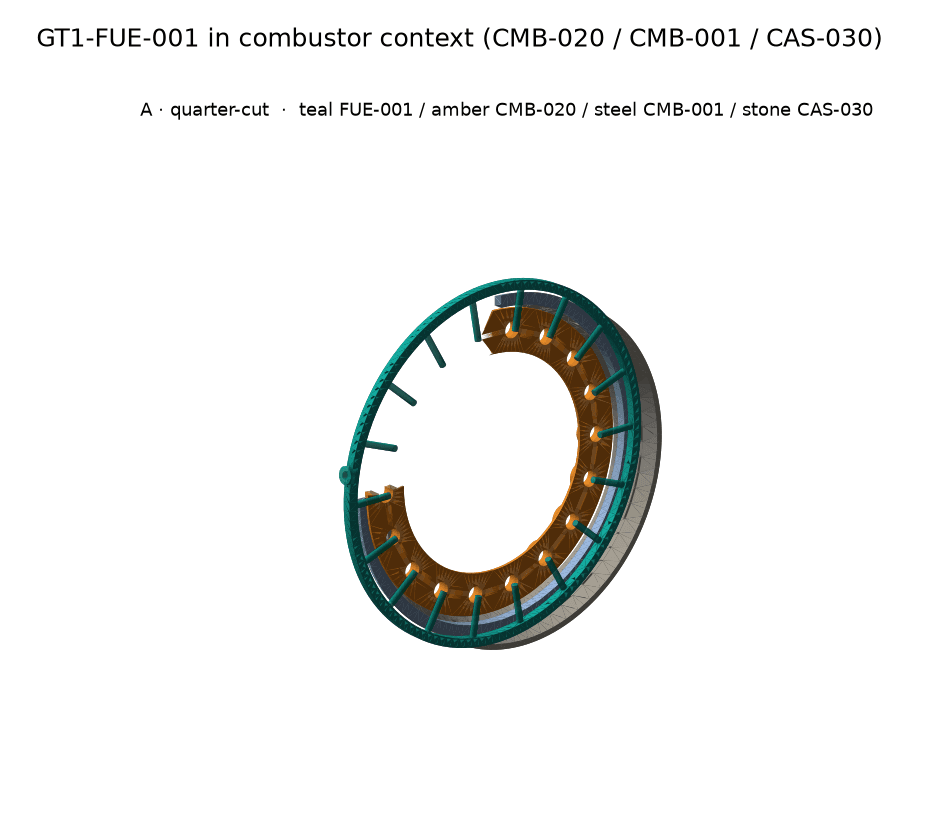
The cutaway shows what "fitting in" actually means here: the ring sits inside the combustor architecture with the stems landing on the swirler array, and a single inlet boss reaching out through the casing: one external connection feeding all eighteen injectors.
Why one part matters
A fuel manifold is where an engine programme finds out whether its combustor packaging was real. Eighteen bores at fixed clockings, a pressure boundary around them, and a flow budget that punishes wishful geometry: either the parts coexist or they don't. These ones coexist, and the proof is a receipt anyone can re-run: the build script is deterministic, and re-executing it regenerates the solid and every measurement above.
The design now entering the promotion pipeline is a sub-kilogram part in a nickel superalloy, the alloy called out in the program's material decisions, routed so the casing needs exactly one new penetration. Screening-tier evidence today, promotion track next, physical release only when the gates say so. That discipline is the product: geometry that arrives with its own measurements attached.
Follow the whole engine on the Orion page, and the pipeline that builds it on the Method page.