REFERENCE DESIGN RELEASE: SEALED GEOMETRY, CLOSED MASS BUDGET, SIX TEST CARDS PASSED.
PROJECT 002: TARGET DRONE
Orion-T1 target drone
A target drone exists to be flown against: test and evaluation, operator training, payload proving. A reusable, recoverable aircraft that flies the profiles manned aircraft shouldn't. T1 is the airframe Genesis Ventures built around the Orion engine.
- BLOCK
- Block 2
- MTOW
- 696.5 kg
- LENGTH
- 5,100 mm
- ROLE
- Concept target drone
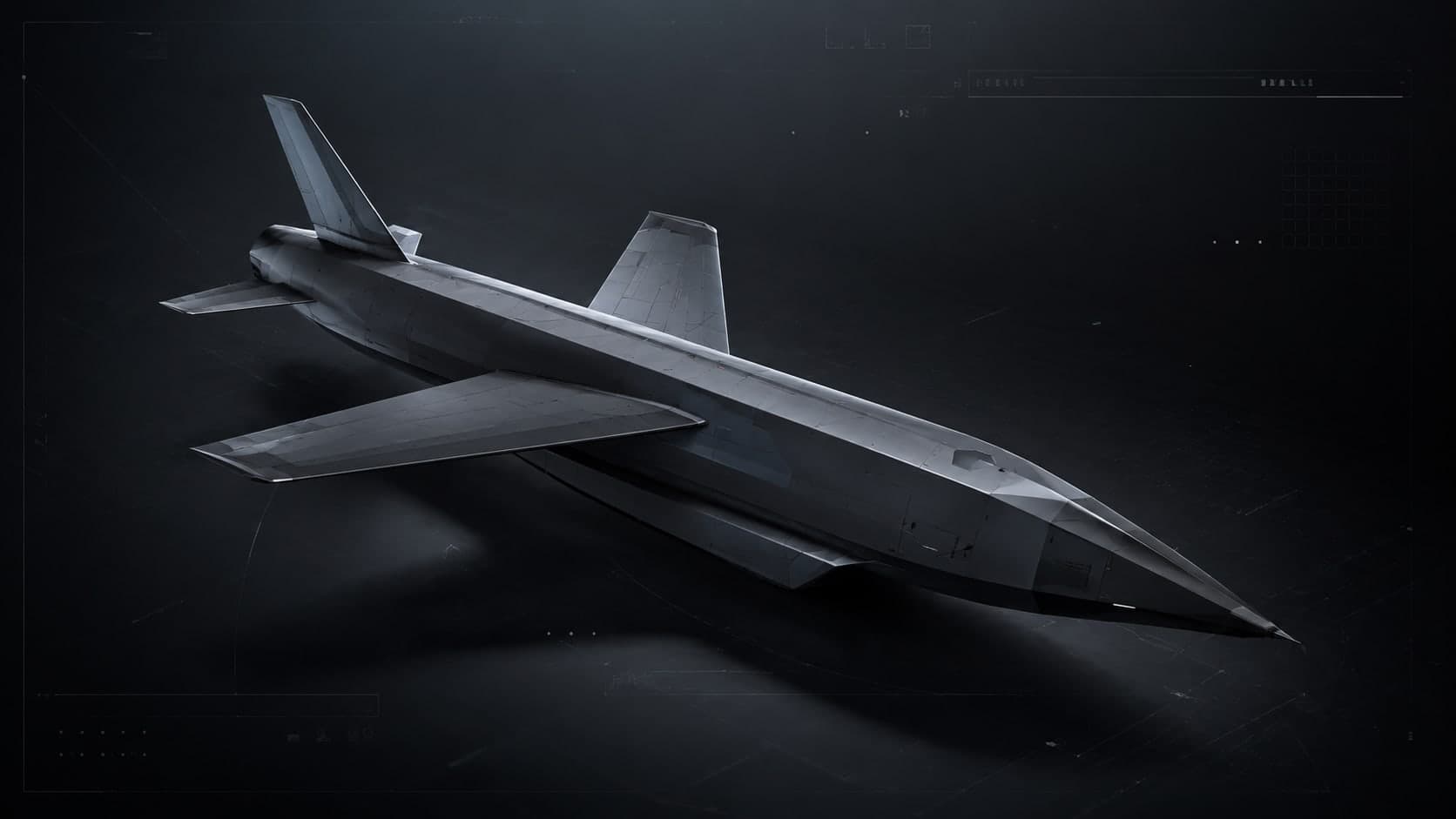
Configuration
- Length
- 5,100 mm
- Max section
- 550 × 580 mm superelliptic
- Fineness ratio
- 9.3
- Wing
- 2.2 m² · 3.4 m span · AR 5.25 · 28° QC sweep
- Horizontal tail
- 0.45 m² · 1.5 m span · 25° sweep
- Vertical tail
- 0.35 m² · 0.9 m high · 38° sweep
- Engine face station
- x = 2,900 mm
- Nozzle exit station
- x = 4,280 mm
Mass breakdown: MTOW 696.5 kg
Thin-wall skin estimate: surface area × gauge × density × non-optimum factor, plus a declared systems budget and the engine mass model. No back-solved densities and no ballast tuned to force a centre of gravity.
Balance
- MTOW
- 696.5 kg
- EMPTY
- 541.0 kg
- CG
- 2,497 mm (49.0% length)
- STATIC MARGIN
- 0.130 MAC
- MAX TRIM ANGLE OF ATTACK
- 49.1° against 12.2° at CLmax
- ENGINE BAY CLEARANCE
- 15.55 mm radial, verified
The wing station is solved for the target static margin from the CAD-derived centre of gravity, not positioned by eye. Engine bay clearance is measured against the repaired engine mesh.
6-DoF flight test program: six tests, six passes.
Both the aircraft and the engine deck are generated from the design files: the thrust and TSFC tables are evaluated straight from the cycle equations, not fitted to them.
| TEST | CONDITION | MEASURED | EXPECTATION | RESULT |
|---|---|---|---|---|
| T1Trim | 5 km / M0.70 | α −0.47°, throttle 0.411; 30 s drift Δh 66 ft, ΔM 0.002 | Steady level flight | PASS |
| T2Launch separation | 3 km / M0.45 | max α 1.0°, max altitude loss 16 ft, ROC +192 fpm by t=15 s | α < 12°, loss < 300 ft, positive ROC | PASS |
| T3Max level speed | 5 km, military thrust | stabilised Mach 0.967 | Mach ≥ 0.75 | PASS |
| T4Climb | 1 → 5 km at M0.55 | initial ROC 22,114 fpm; 30.5 s to 5 km | initial ROC > 7,874 fpm | PASS |
| T5Sustained turn | 30° bank, 5 km, 60 s | mean bank 29.6°, max |Δh| 17 ft | altitude within ±164 ft | PASS |
| T6Fuel & thrust anchors | cruise + two off-design points | TSFC 129.0 vs cycle 128.9; thrust error 2.3% and 4.1% | within ±10% of the cycle model | PASS |
How the model is wired
- Both the aircraft and the engine deck are generated from the design files: nothing is hand-maintained.
- Thrust and TSFC are full altitude × Mach tables evaluated straight from the cycle equations.
- Wetted areas come from the CAD solids rather than rules of thumb.
- The simulator reproduces all three published operating points to better than 1e-6 relative.
Built around Orion
T1 is not an airframe with an engine bolted in: it was closed around the Orion turbojet from the inlet face to the nozzle exit station. The engine deck that powers the flight model is evaluated straight from the published cycle equations.
THE ORION ENGINE →Every published figure is backed by declared thresholds and 6-DoF flight test simulation correlated against the cycle model.
Need a target platform or a custom airframe?
T1 is the published proof. Derivatives and new airframes are scoped per program. Bring the mission profile.
TYPICAL D3 FEE · $55,000-$90,000
START A DESIGN INTAKE →